The Decider
Decision Support System
Concept, UX-UI Design
07/2022
Figma
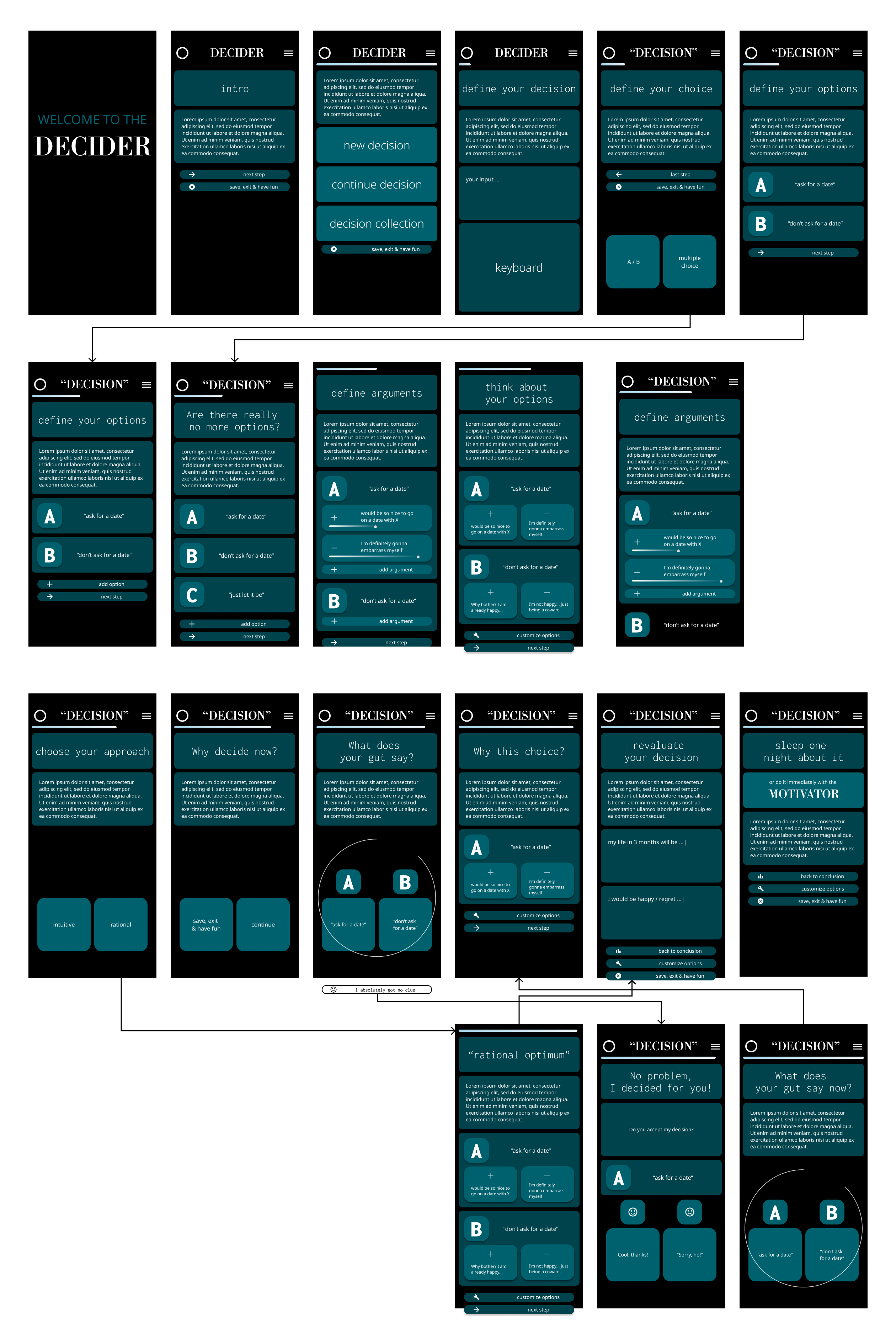
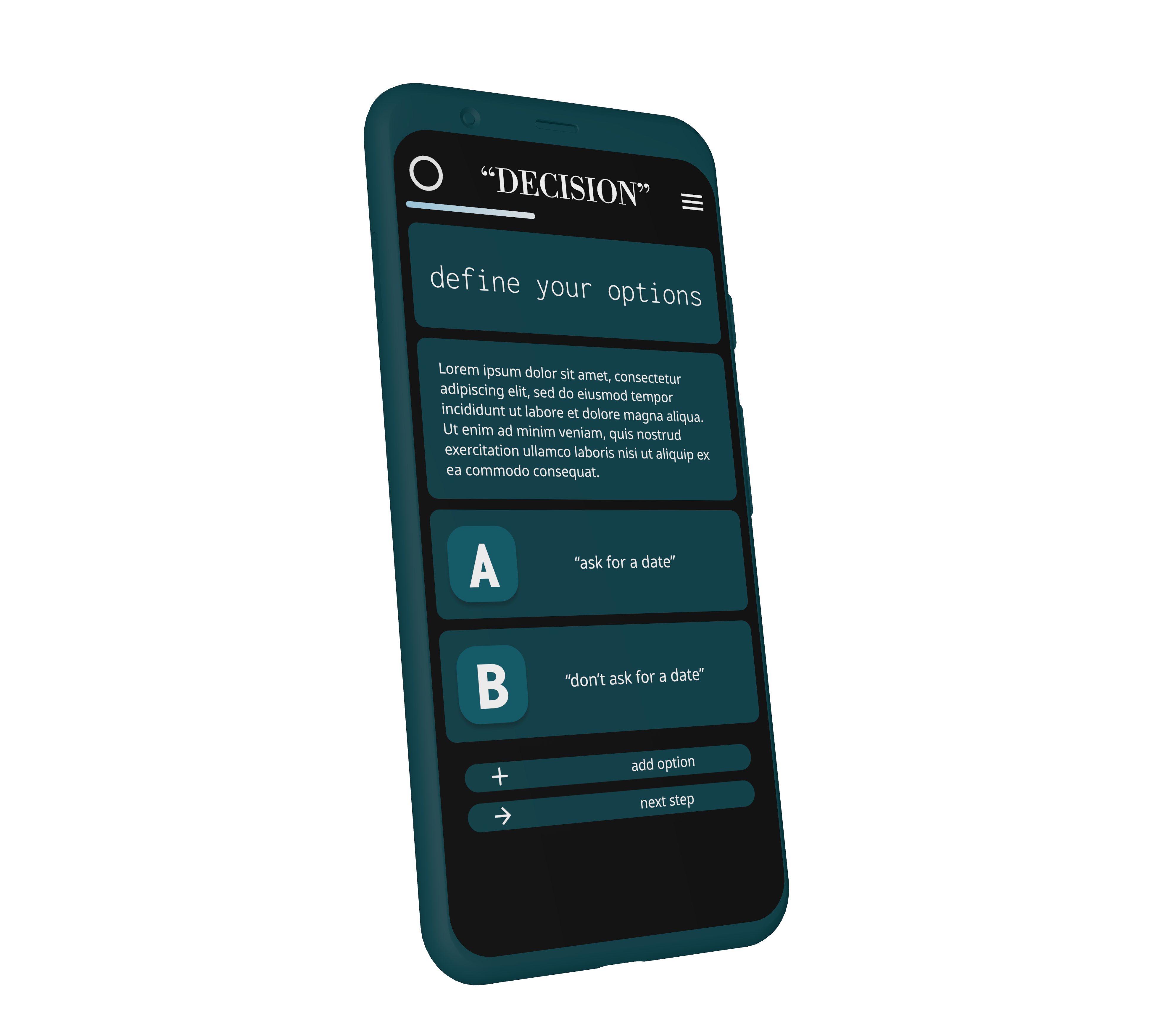
The Decider, is a self-reflection-interface intended to help people find their true opinion through supporting rationalization or enhancing intuition.
Since my friends and family members often consult me on their decision-making processes, I had the idea to develop a tool for this specific task. It is generally not easy for us humans to make decisions and there are many decision support systems (DSS) to facilitate this process already. Interestingly, when I looked around for potential competition for my product idea, I noticed that most apps for this purpose either don’t work well or have a terrible interface. Another issue was that it was difficult to understand how the DSS functioned. As a result, I concluded that the challenge of such a product is to be efficient while also being intuitively usable.
During my studies in cognitive science I had already dealt with the processes of human decision-making in detail. With this background, I was fortunately able to quickly gain an overview of the complexity of decision-making and break it down into smaller aspects to work with further.
There are two approaches for us humans to make a decision: the rational and the intuitive way. Both have their advantages, disadvantages and factors that influence the process:
Rational decision-making
+
only if an optimal solution is possible
fact driven approach: minimizing biases, enhancing objectiveness
–
not a very human approach
due to our lack of cognitive capacities and optimization
(motivation ends as soon as a sense of satisfaction is reached -> no ongoing optimization)
time consuming
limits of information / knowledge / anticipation
quantity, quality, accuracy and integrity of information are often missing
cause-effect relationships are not clearly discernible
Intuitive decision-making
+
good for low value decisions
speed
a certain degree of intuition is required
(more difficulty in decision making -> less intuition).
ability that can be improved through learning
–
inaccurate, insufficient, unreliable and unrelated information is indistinguishable
inappropriate application possible (example: overconfidence)
short term emotional bias
(even experts can be influenced by unrelated emotions)
bias due to prejudice (example: lack of openess)
insufficient consideration of alternatives – limits of information
(intuition relies on pattern-recognition -> limiting options)
heuristics and habits
So how do we choose the right approach for an upcoming decision?
To answer this question, I have compiled some (certainly not all) decisive factors:
Time
How much time can be invested in the decision-making process? More time -> more effective analysis of situation possible. (Risk of overanalyzing -> analysis paralysis.)
Value
Importance of the decision result. Higher value -> requires more consultative / collaborative approach.
Quality
How to define the optimal solution? Is a satisfactory outcome sufficient, or is maximization/optimization of the solution required? (Risk of moderate solution bias, criterions for quality could be: level of action, social harmony, self-actualization.)
Commitment to implementation
Are the options of the decision realistically implementable? -> Many decisions fail at this point because the acceptance / commitment is too low.
Relationship impact
If the decision is embedded in a social context -> decision-making approach should include social factors.
Complexity
Are the options imaginable without additional help? Is the decision comprehensible?
Biases
Both deicision-making approaches contain sources of bias -> How to deploy bias filter?
Objectives
What is the motivation behind the decision? A decision that deals with the fear of losses is something completely different from a decision about possible gains.
Uncertainties
Always play a role. The question is which.
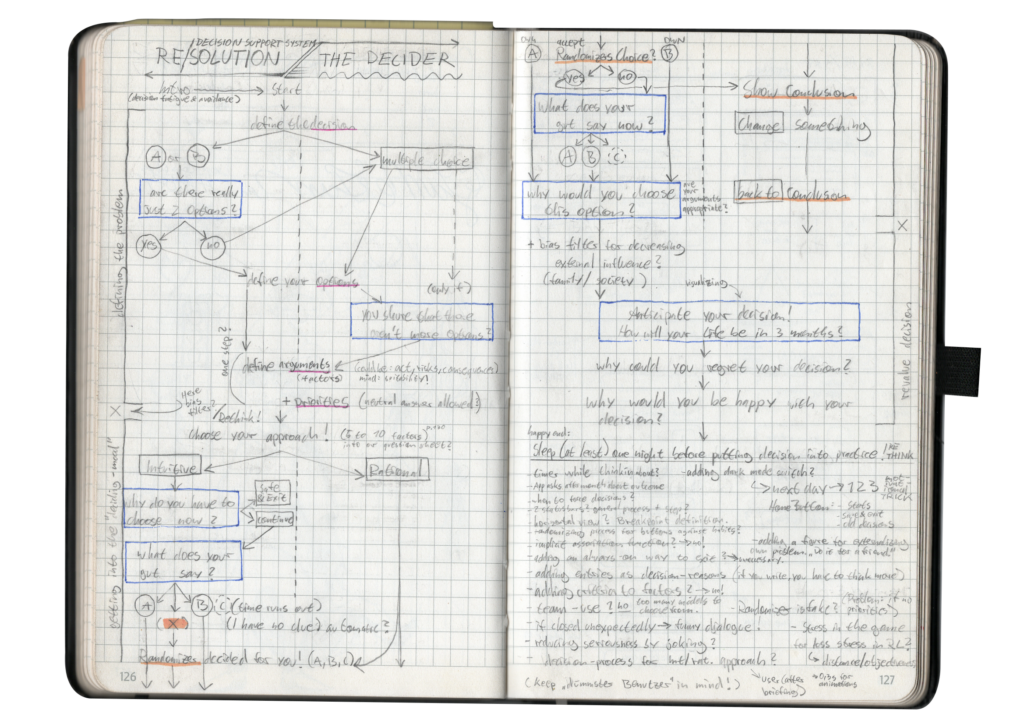
With my theoretical findings in mind, I began to design a process for my app that incorporates both rational and intuitive decision-making approaches, as well as methods for filtering biases.
The user journey is divided in three sections:
1. Identifying the problem
2. Getting into the decisive mood
3. Reevaluation of the decision
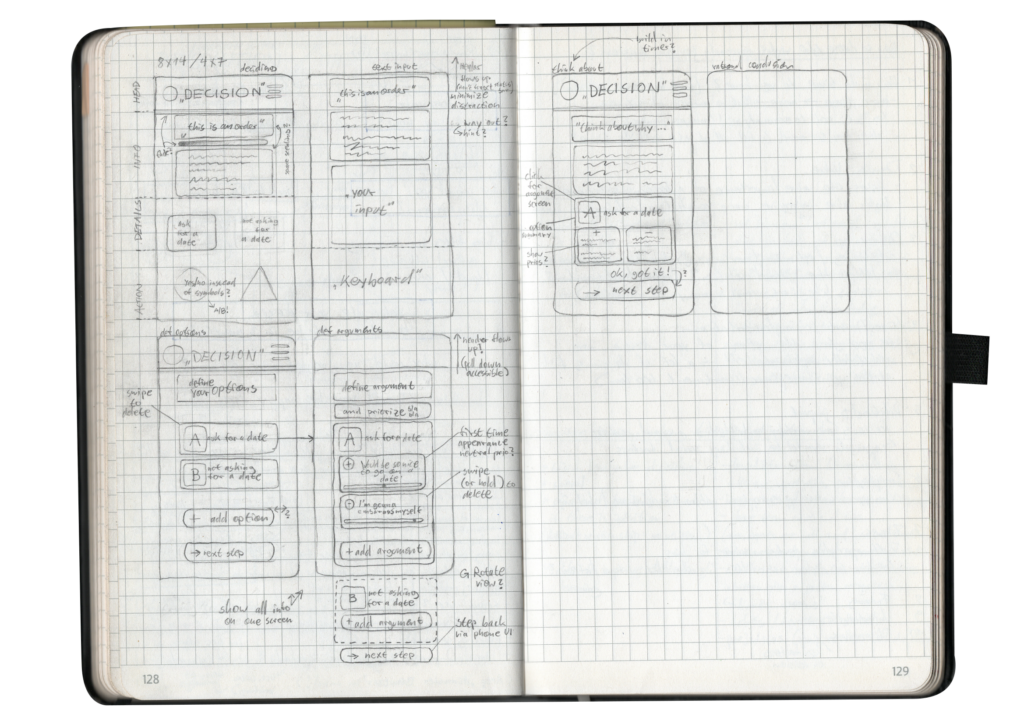
Once the flow was clear, I started designing the wireframe.